
What Is the House Edge in Gambling?
The house edge in gambling is the mathematical advantage a casino has over players, expressed as a percentage.
It shows the portion of your bets that a casino expects to keep on average after a very large number of wagers.
For example, a game with a 2% house edge returns about $98 of every $100 wagered to players over time, while the casino keeps about $2 on average.
Every casino game has a house edge. However, it’s important to remember that the percentage does not predict what will happen in a single session or on any individual bet. Instead, it describes the expected average result across millions of bets.
This guide explains everything you need to know about the casino house edge, including:
- How casinos calculate the house edge
- How it compares to return to player (RTP)
- How the house edge applies to slot games
- How to use it when choosing which casino games to play
How the House Edge Is Calculated

The casino house edge comes from the difference between an outcome’s true odds and the payout a casino offers when that outcome wins.
Take a straight-up bet on a single number in American roulette as an example. The wheel has 38 pockets, so the true odds of hitting one specific number are 1 in 38.
And yet, the casino pays only 35-to-1 when you win. That difference creates the house edge.
You can calculate house edge for yourself, following the steps below:
- Find the true odds. A single number has a 1 out of 38 chance of winning.
- Find the payout odds. American roulette pays 35 to 1 on a winning straight-up bet, aka betting on one number.
- The difference is the house edge. This difference of 1 in 38 true odds and a 35 to 1 payout comes out to a house edge of 5.27%. That means that, on average, a player loses about 5.26% of all money wagered on this bet over the long run.
It’s important to note that although the house edge applies to each game, it is not a prediction for a single session.
You can still win multiple times in a row or lose much faster than the average suggests. The house edge applies over a long period of play.
House Edge vs RTP: The Same Number From Two Ends
House edge and return to player (RTP) measure the same value from opposite sides.
The house edge shows the percentage of wagers the casino expects to keep over time, while RTP shows the percentage the game expects to pay back to players over time.
The two figures always add up to 100%.
For example:
- A 96% RTP game has a 4% house edge.
- A 97% RTP game has a 3% house edge.
The reverse works the same way:
- A 2% house edge equals 98% RTP.
- A 5% house edge equals 95% RTP.
If you’re playing slots, you’re much more likely to see RTP than house edge. Online casinos and game providers typically publish the slot’s RTP in the game’s paytable, information screen, or game rules.
| House Edge | RTP | |
| What it measures | Percentage of wagers the casino expects to keep | Percentage of wagers the game expects to return to players |
| Whose side it describes | Casino | Player |
| Where a player usually sees it | Guides, reviews, and strategy articles | Paytable, information screen, or game rules |
| Figure on a 96% RTP slot | 4% | 96% |
| What a higher number means for the player | Less favorable | More favorable |
The House Edge in Online Slots
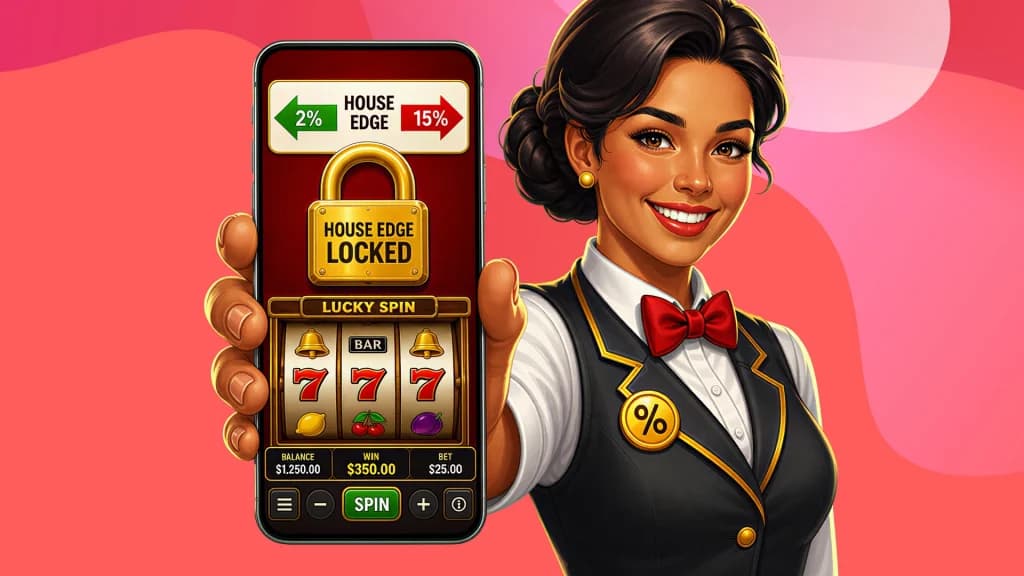
A typical slots house edge is about 2% to 15%, depending on the game. The exact figure comes from the slot’s return to player (RTP), which the game developer sets when designing the paytable and payout structure.
The casino does not adjust the house edge, either before or while you play. They don’t even have access to the “controls” or the backend.
In terms of gameplay, each spin uses a random number generator (RNG), which is number-jumbling software that produces an independent result every time you hit ‘Spin’.
House Edge vs. Volatility
House edge and volatility measure different aspects of a slot game. Two games can have the same 96% RTP and 4% house edge but play very differently.
Low-volatility slots pay smaller prizes more often, so your bankroll usually lasts longer. You would play low-volatility slots if you wanted a steadier session with fewer bankroll swings.
High-volatility slots produce longer losing streaks but offer larger payouts, albeit less frequently.
Understanding what volatility is in slot machines helps explain why two games with the same house edge can feel completely different.
Locating the House Edge
Slots state the RTP percentage instead of the house edge. To determine the house edge, you have to find its RTP and calculate it.
Open the game’s paytable or help screen, indicated by a ‘?’, ‘i’, or three horizontal lines. When you find the RTP, subtract that number from 100%. For example, a slot with 96.5% RTP has a 3.5% house edge.
Suppose you play a 96% RTP slot at $1 per spin for 500 spins. You wager $500 in total. The theoretical house edge is 4%, so your expected loss over the long run is about $20.
That said, in a real session, you could lose much more, lose less, break even, or finish ahead because every spin is random.
Slots generally have a higher house edge than many table games because they offer other, higher-paying hits that balance it out, such as bonus rounds, free spins, jackpots, and much higher maximum payouts.
House Edge by Casino Game
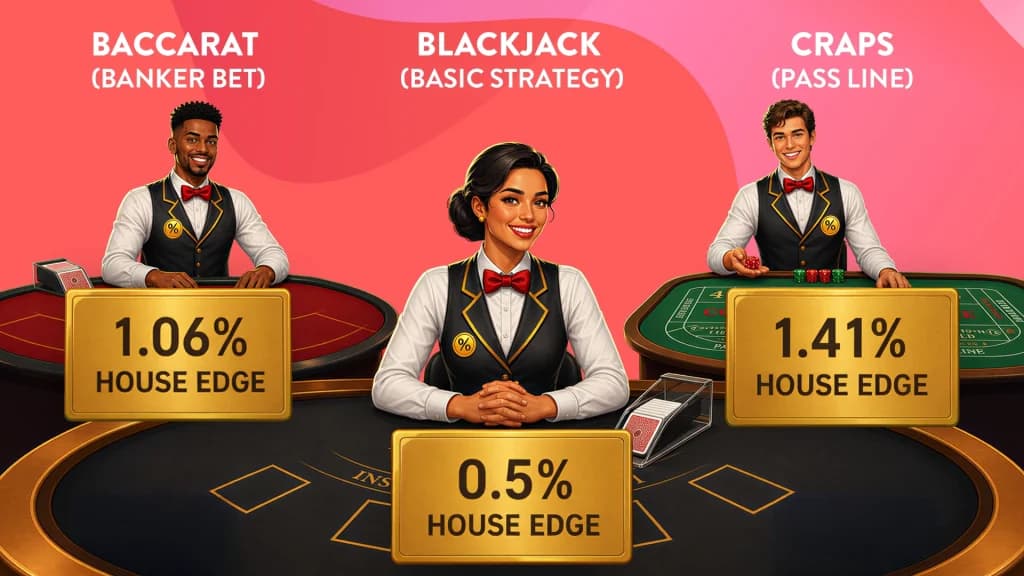
The house edge varies widely between casino games. In almost all games outside of slots, including blackjack, baccarat, and craps, it changes depending on the bet you make or whether you use the correct strategy.
| Casino Game | Typical House Edge | Equivalent RTP | What Sets the Figure |
| Blackjack (basic strategy) | About 0.5% | About 99.5% | Table rules and player strategy |
| Baccarat (Banker bet) | 1.06% | 98.94% | Fixed game rules and 5% Banker commission |
| Craps (Pass Line) | 1.41% | 98.59% | Bet type (odds bet has 0% house edge) |
| European roulette | 2.70% | 97.30% | Single-zero wheel |
| American roulette | 5.26% | 94.74% | Double-zero wheel |
| Video poker (full-pay, optimal play) | About 0.5% | About 99.5% | Paytable and player strategy |
| Online slots | Typically 2%–15% | Typically 98%–85% | Game RTP set by the developer |
| Keno | Typically 20%–25% | Typically 80%–75% | Game paytable |
Most slots have a higher house edge than your standard table game, but they also offer payout-boosting mechanics that table games do not, including bonus features, free spins, progressive jackpots, and maximum wins that can reach thousands of times your stake.
Those features are the main reason many players choose slots, even though they have a higher house edge.
How to Play With the House Edge in Mind
No strategy can remove the house edge. The best approach to winning in casino games is to reduce your theoretical cost by choosing lower-edge games and managing your wagers.
When choosing a slot game, start by comparing RTP.
House edge equals 100% minus RTP. Therefore, if you play a game with a higher RTP, you can expect to pay less over the long run.
For example, if you wager $1,000 in total in a 96% RTP slot, you would end up paying about $40. If you pay the same in a 94% RTP slot, you’ll pay about $60.
The total amount you wager is just as important as the game’s house edge.
If you increase your stake size and play for longer, you can expect a higher cost. That’s why it’s essential to practice good slots bankroll management, as it’s the only way to control how much you risk during a session.
Many players use betting strategies as a form of bankroll management, such as the Martingale, Fibonacci, or 1-3-2-6. While these are useful for managing your bankroll, they do not change the house edge. They only change the size and timing of your bets.
Adding to that, even if you’ve lost multiple times in a row, a game is never “due” to pay. Every slot spin is independent because the random number generator produces a new result each time. Previous wins and losses do not affect the outcome of the next spin.
Always be sure to set a budget before you play, use deposit limits where available, and never chase losses.
The House Edge in One Line

The house edge is the percentage of every wager a casino expects to keep on average over the long run.
Because the house edge is fixed and published before you play, you can compare games, estimate your theoretical cost, and choose stakes that fit your bankroll and the type of session you want.
Just remember that a lower house edge reduces your expected cost over time, but it does not guarantee better short-term results.
At SlotsLV Casino, you can make informed decisions by reviewing the house edge alongside game features, RTP, and volatility, then choose the best slots to play online for real money.
More About Slots House Edge
What does a 2% house edge mean?
A 2% house edge means the casino expects to keep about $2 for every $100 wagered over the long run. It is a mathematical average based on a very large number of bets, not a prediction of what will happen in a single session.
What is the house edge on slots?
Online slots typically have a 2% to 15% house edge. The exact figure depends on the game’s RTP. For example, a slot with a 96% RTP has a 4% house edge.
Is house edge the same as RTP?
They are two sides of the same figure that always add up to 100%. For example, a slot with a 96% RTP has a 4% house edge.
Which casino games have the lowest house edge?
Blackjack has one of the lowest house edges at about 0.5% when you use perfect basic strategy. Full-pay video poker can also reach about 0.5% with optimal play, while the Banker bet in baccarat has a 1.06% house edge.
Can you beat the house edge?
No. No betting system or strategy removes the house edge. You can lower your expected cost by choosing games with a lower house edge, managing your bankroll, and controlling how much you wager.
Does a house edge mean I will always lose?
No. You can win or lose in any session because every result is random. The house edge describes the expected average outcome over a very large number of bets, not the result of a single session.
Do online slots have a lower house edge than land-based machines?
Sometimes. Online slots often publish RTP figures, and many offer higher RTPs than traditional land-based machines. However, the house edge depends on the individual game’s RTP, not simply whether it is played online or in a physical casino.